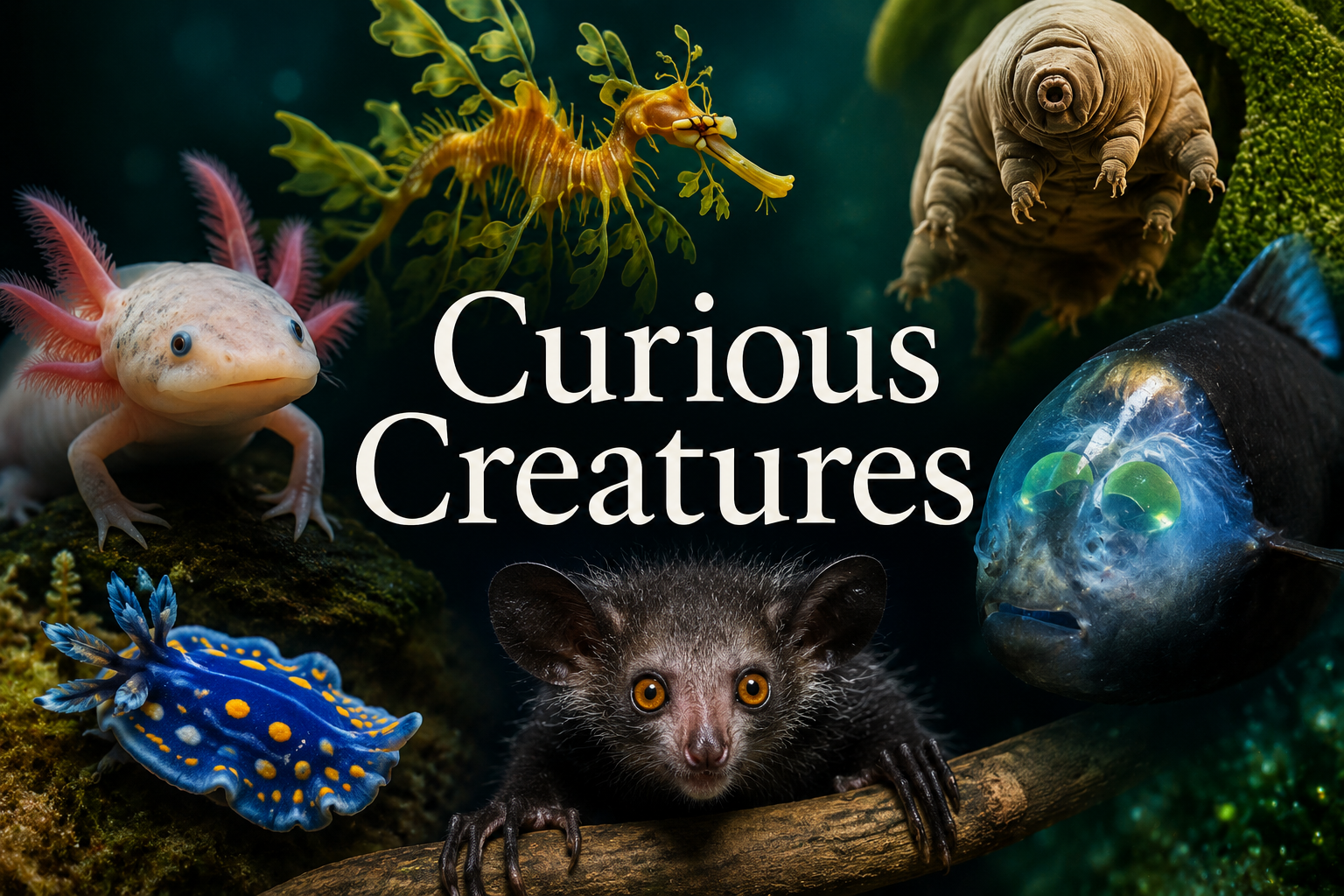

Science keeps proving one thing: the animal kingdom is far stranger than anyone expected. From deep-sea crustaceans that look like sci-fi nightmares to mice that try to wake their unconscious companions, curious creatures are turning long-held assumptions upside down.
| Metric | Value | Description |
|---|---|---|
| New species described by the Natural History Museum in 2024 alone | 190 | New species described by the Natural History Museum in 2024 alone |
| Of all animal species on Earth discovered so far | <15% | Of all animal species on Earth discovered so far |
| Depth where a new predatory crustacean was found alive in 2024 | 25,900 ft | Depth where a new predatory crustacean was found alive in 2024 |
The ocean floor is still full of surprises
For years, the Atacama Trench off the coast of Chile was written off as uninhabitable. Too deep, too dark, too much pressure. Then scientists found Dulcibella camanchaca living quite comfortably down there at 25,900 feet. This bone-white, 4-centimeter crustacean turned out to be the first known predatory amphipod species from the hadal zone. It hunts by scooping up smaller prey with what researchers at the Woods Hole Oceanographic Institution described as “raptorial” appendages.
Around the same time, a deep-sea slug, Bathydevius caudactylus, was spotted glowing in the Pacific’s midnight zone at depths of up to 13,000 feet. Researchers at the Monterey Bay Aquarium Research Institute confirmed through DNA analysis that it belongs to the nudibranch family. Nobody expected nudibranchs at that depth.
Worth noting: Scientists estimate less than 15% of all animal species on Earth have been identified. Every deep-sea survey makes that figure feel even more conservative.
New species that sound like they were invented
Meet some of the most genuinely strange additions to the known animal catalog from 2024 and 2025.
Myloplus sauron
A plant-eating piranha from Brazil’s Xingu River, named after the Lord of the Rings villain for its flame-orange fins. Exclusive to a 1,238-mile stretch of river.
Skeleton panda sea squirt
A transparent filter feeder with white blood vessels resembling a rib cage and black-and-white markings at its base. It has no brain and no real nervous system.
Bird tear-drinking moth
Hemiceratoides avimolestum, from Madagascar. It waits until birds are asleep, then inserts its proboscis into their eyes to drink tears.
Cassiopeia fanged frog
A new frog species from Luzon in the Philippines, identified by researchers from the University of Kansas. Males have small chin protrusions that earned them the “fanged” nickname.
Animal behavior that nobody saw coming
New species aside, familiar animals have been doing things that leave researchers genuinely puzzled.
Wolves outsmarting traps
In Canada, a female wolf was caught on camera swimming to a submerged crab trap, dragging it ashore, opening it, and eating the bait inside. The researchers working with Indigenous Haíɫzaqv guardians documented this in 2025. The wolf appeared to understand there was food inside a hidden, submerged container. That is problem-solving that most people would not attribute to a wild wolf.
Mice reviving their companions
A study published in the journal Science in 2025 placed healthy lab mice near recently anesthetised ones. The healthy mice sniffed, groomed, and then began pawing at and nipping the unconscious animals, appearing to try and wake them up. Elephants, chimps, and dolphins have shown similar behavior before. Mice had not made that list, until now.
Elephants calling each other by name
Wild African savannah elephants appear to address one another using individualized calls that function similarly to names. Cornell University behavioral ecologist Michael Pardo’s team analyzed 469 calls from elephant groups in Kenya’s Amboseli National Park and found strong evidence for name-like vocalizations, a trait documented in very few non-human species. The findings appeared in Nature Ecology & Evolution in June 2024.
From Popular Science, December 2024: Wild African savannah elephants appear to address one another with name-like calls, a trait that is “very rare among non-human animals.” Machine-learning methods were used to analyze the calls, and playback experiments confirmed individual recognition.
Creatures that redefine what bodies can do
Some of the most talked-about curious creatures in recent science are not newly discovered but rather newly understood.
- Tardigrades: These microscopic animals can go dormant when conditions become hostile. In 2024, researchers found that when exposed to deadly radiation, tardigrade cells activate hundreds of genes simultaneously to repair DNA at what biologist Courtney Clark-Hachtel from a collaborating study described as a “ridiculous” level of efficiency.
- Chinstrap penguins: They sleep over 10,000 times per day, with each nap lasting around four seconds. That adds up to more than 11 hours of total rest while maintaining near-constant alertness to protect their eggs.
- Wrens: Australian researchers confirmed that mother wrens sing a specific call to their eggs before hatching, and the chicks reproduce that call after they are born. The same behavior has been found across multiple wren species, suggesting the practice may go back millions of years.
- Cuttlefish: Research led by behavioral ecologist Alexandra Schnell found that cuttlefish can delay gratification for up to 50 to 130 seconds while waiting for a better food reward, a patience level comparable to that of chimpanzees, crows, and parrots.
Why this all matters more than you might think
The pace of discovery is accelerating. DNA sequencing, AI-assisted species classification, deep-sea robotics, and camera trap networks are pulling back the curtain on parts of the natural world that were invisible just a decade ago.
As Dr. Tim Littlewood, Director of Science at the Natural History Museum, put it after his team described 190 new species in 2024: “In order to fix our broken planet, we need to keep learning about how life evolves and how vital its diversity is in keeping nature healthy.”
The curious creatures coming out of forests, ocean trenches, and university campuses are not just trivia. They are data points in a much bigger picture of how life adapts, survives, and cooperates. And by almost every measure, that picture is far more complex and interesting than the one most people walked into science class with.
What we are still missing is the larger question. With less than 15% of animal species documented, whatever has already surprised us is just the beginning for curious creatures science has yet to meet.