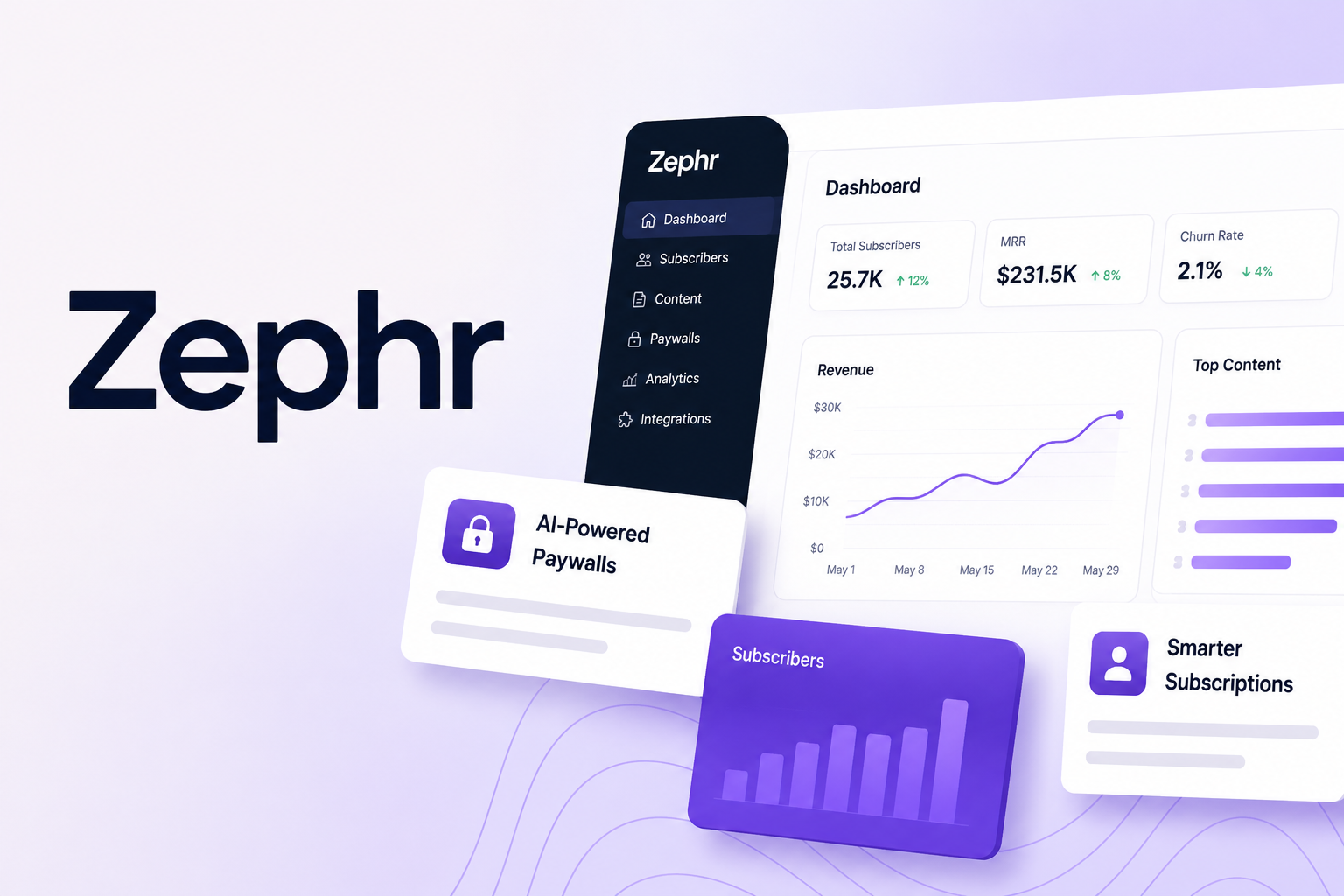

Publishers are under pressure to convert anonymous visitors into paying subscribers. Zephr is the platform many of the world’s biggest media brands are using to do exactly that.
Zephr is a subscription experience platform built for digital publishers and media companies. It handles the full stack of subscriber conversion — from the first time someone lands on an article to the moment they hand over a credit card number, and everything that follows. The platform now operates under Zuora’s product suite after a $44 million acquisition in 2022.
In plain terms: Zephr puts the right paywall, offer, or registration prompt in front of the right reader at the right time, without a publisher needing to call in a developer every time they want to run a test.
8B+ Requests processed monthly
$44M Zuora acquisition price (2022)
30+ Third-party integrations
How Zephr actually works
Most publishers still run on static paywalls: after three free articles, you see a wall. Everyone gets the same wall. Zephr’s pitch is that this model leaves money on the table. A first-time reader who landed from social media needs different treatment than a user who has visited 40 times without subscribing.
Zephr’s engine uses behavioral and contextual data to decide which experience each visitor sees. That decision happens in real time. The platform’s AI layer runs on reinforcement learning, meaning it keeps updating based on what actually converts, without a human having to adjust settings manually.
| Feature | Description |
|---|---|
| Dynamic paywalls | AI selects which paywall type to show each user based on their behavior and engagement signals. |
| Identity and access management | Handles login, MFA, SSO, and account-sharing detection for B2C and corporate accounts. |
| A/B and multivariate testing | Teams can build, launch, and rebuild subscriber journeys in minutes without engineering support. |
| Corporate subscription tools | Manages large B2B accounts with federated access, IP whitelisting, and soft login limits. |
The four paywall types Zephr supports
- Soft paywall — Offers a portion of free content to build familiarity before asking users to subscribe.
- Metered paywall — Allows a set number of free articles per month, then restricts access, keeping search-indexed content visible.
- Hard paywall — Full access restriction for premium, high-value content targeting loyal or return audiences.
- Dynamic paywall — AI-assigned paywall type per user, selected based on real-time behavior and propensity data.
Who uses Zephr
Zephr counts some of the largest media operations in the world as clients. The platform has been used by publishers dealing with scale: millions of anonymous monthly visitors who need to be moved toward registered users and then paying subscribers.
| Company |
|---|
| Forbes |
| The Irish Times |
| The Globe and Mail |
| News Corp |
| Guardian News & Media |
| DAZN Group |
| Penske Media Corporation |
| Dennis Publishing |
According to figures cited by Zephr, publishers using retention-focused features on the platform have seen a 25 to 30 percent uplift in retention revenue. Separate data shows one Zephr client recorded a 200 percent increase in click-through rates to paywall pages after switching to personalized marketing emails triggered by Zephr’s subscriber journey data. A US publisher that ran geo-targeted offers tied to specific sports teams beat its subscriber acquisition target by 300 percent within two weeks.
The Zuora acquisition and what changed
- 2017
Zephr founded in London, begins working with digital publishers including News Corporation and Dennis Publishing.
- August 2022
Zuora announces intent to acquire Zephr for $44 million in cash plus up to $6 million in earnout consideration.
- September 2022
Acquisition closes. Zephr becomes part of Zuora’s product portfolio, adding subscriber experience capabilities to Zuora Billing.
- 2024 onwards
Zephr’s AI paywall capabilities expanded. Platform now handles over 8 billion requests per month across its publisher base.
The Zuora deal gave Zephr access to transaction data from tens of billions of dollars in quarterly billing volume. That matters because Zephr’s personalization engine gets sharper with more data. Zuora’s CEO Tien Tzuo described the combination as creating a platform that helps companies understand subscribers, shape the right offerings, and improve conversion, retention, and growth simultaneously.
What sets it apart from a basic paywall
Standard paywalls are one-size tools. Zephr’s case is that static rules and simple A/B tests stop short because they treat all users within a segment the same way. The platform’s AI layer uses reinforcement learning, which means it does not wait for humans to analyze results and update settings. It observes what works and adjusts automatically.
Publishers can also run the platform without writing code. The drag-and-drop rules builder includes 50-plus pre-made decision points and customizable paywall templates. That allows commercial and editorial teams to launch new subscription products, offers, and pricing experiments without waiting for engineering resources to free up.
“It’s five times harder to acquire someone than it is to retain someone, and yet often publishers are focused solely on acquisition.”
James Danczak, Zephr — Press Gazette Paywall Strategy Summit
Data compliance and security
Zephr collects first-party data, meaning data the publisher owns and the user knowingly provides. The platform operates under GDPR and CCPA frameworks. Security features include multi-factor authentication, passwordless login options, and account-sharing detection for both consumer and corporate subscriber accounts.
| Relevant Terms to Know |
|---|
| Subscription experience platform |
| Dynamic paywall |
| Metered access |
| Subscriber journey |
| First-party data |
| Reinforcement learning |
| Identity management |
| Churn reduction |
| B2B subscriptions |
| Zuora Bi |
Zephr sits at a specific intersection: publishers who need more than a basic paywall plugin but do not want to build subscriber management infrastructure from scratch. With AI-driven paywall optimization, no-code journey building, and deep integration into Zuora’s billing infrastructure, it targets media companies operating at scale where the difference between a flat wall and a personalized offer can move subscriber numbers materially.