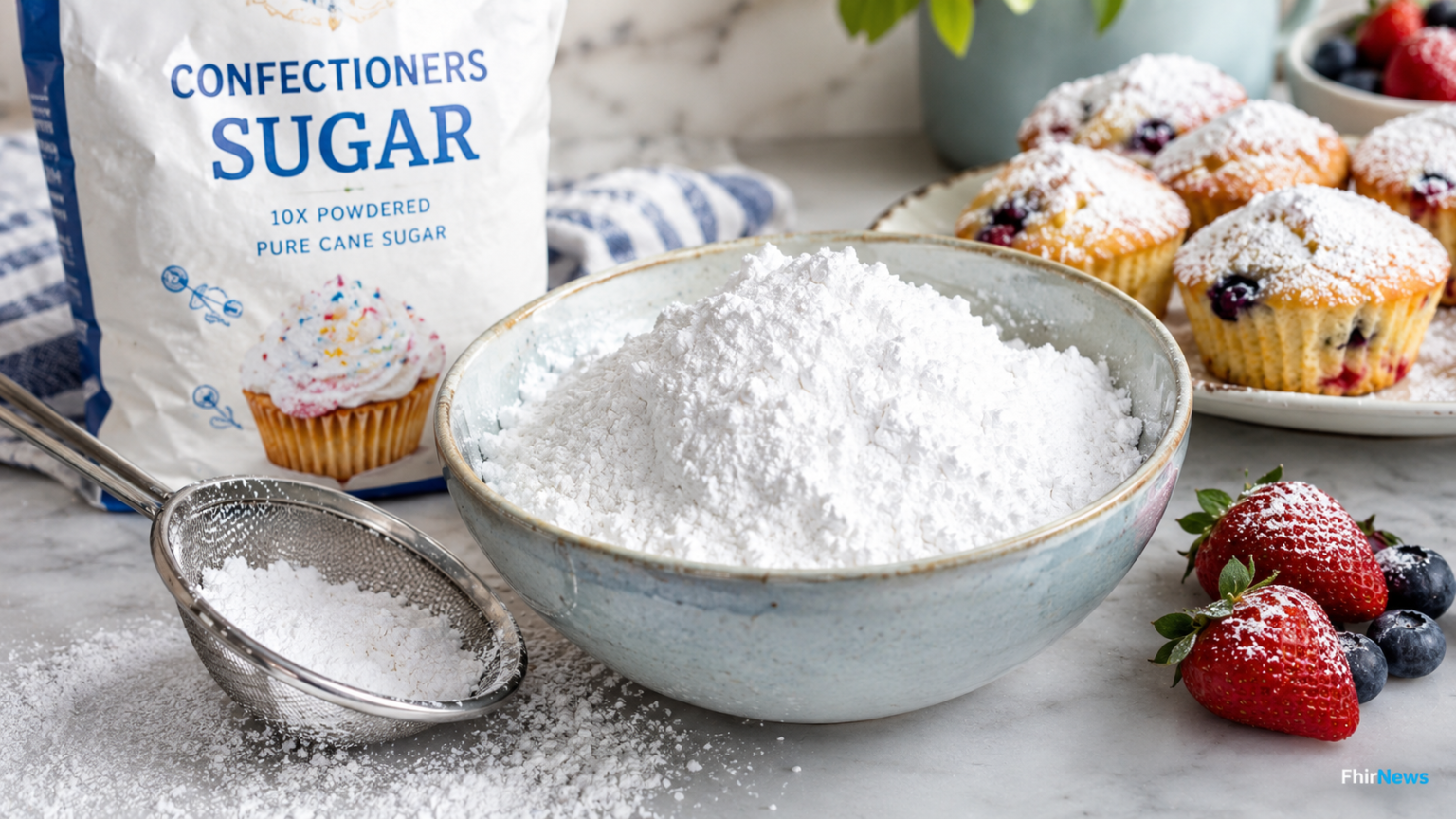

It is ground sugar with a little starch, and the small print on the bag changes how your icing turns out.
Confectioners sugar, also sold as powdered sugar or icing sugar, is granulated sugar ground into a very fine powder, usually with a small amount of cornstarch added to keep it from clumping. It dissolves quickly, which is why it ends up in frosting, glazes and the white dusting on cookies and donuts.
Recipes treat it as a basic ingredient, yet the box rarely says why the bag carries a number like 10X or whether regular sugar can stand in.
At a glance
- Confectioners sugar is sugar plus a small amount of starch, about 3 percent in Domino’s version.
- Powdered sugar and icing sugar are the same product for most baking purposes.
- A cup of it weighs much less than a cup of granulated sugar, so the two do not trade places evenly.
- Keep it dry. Moisture turns it into lumps.
What Goes Into a Bag of Confectioners Sugar
The label usually lists two ingredients, sugar and cornstarch. King Arthur Baking describes it as granulated white sugar ground fine with a bit of cornstarch to prevent clumping, and Domino’s product FAQ puts that cornstarch at 3 percent.
International food standards set an upper limit. The Codex Alimentarius standard for sugars, hosted by the Food and Agriculture Organization, allows up to 5 percent starch in powdered sugar when no other anticaking agent is used. It also says the label must declare the presence of starch and the maximum amount.
Powdered Sugar, Icing Sugar and Confectioners Sugar, Sorted Out
For most home bakers, the three names point to one product. Food Network traces “confectioners” to the candy makers who used it and says “powdered” describes how it looks. Wikipedia lists icing sugar as a third name.
Strict definitions leave a little room, though. Codex describes powdered sugar, also called icing sugar, as finely pulverised white sugar with or without an anticaking agent, so the ingredient list is the reliable guide to what is in your bag.
The powder is not a modern idea. Wikipedia notes that factory made powdered sugar arrived in the 19th century, and that before then sugar came as a hard loaf. Bakers ground and sieved lumps of it by hand to get fine icing sugar.
Caster sugar is a different product. According to Wikipedia, its particles are about half the size of granulated crystals, and it has no added starch.
What the X on the Label Means
The X is a fineness rating. BakerPedia, a baking industry reference, sorts powdered sugar by particle size, and more Xs mean a finer grind. Its reference table shows the starch share rising a little at the finest grade.
| Grade | Sucrose | Starch |
|---|---|---|
| 6X | 96 to 97 percent | 3 to 4 percent |
| 10X | 96 to 97 percent | 3 to 4 percent |
| 12X | 95 to 96 percent | 4 to 5 percent |
Even the 12X figure stays within the 5 percent ceiling that Codex sets.
What Confectioners Sugar Is Used For
- Icings, frostings and glazes. King Arthur lists all three, and the reason is simple: the powder dissolves easily.
- Cookie coatings. Chocolate crinkles are coated in it for their crackled look, according to King Arthur.
- Confections and fondants. BakerPedia lists bulking as one of its roles in these sweets.
- Meringue. The starch in powdered sugar can help stiffen and stabilize it, BakerPedia adds.
Why Confectioners Sugar Cannot Replace Granulated Sugar
Domino’s FAQ answers the question with “In short, no,” and King Arthur’s sugar guide agrees: “no confectioners’ sugar in place of granulated.” Domino points to the finer crystals and the 3 percent cornstarch, and warns that a swap may give unsatisfactory results.
Weight shows the gap. According to King Arthur’s ingredient weight chart, a cup of the powder weighs far less than a cup of crystals.
| Granulated sugar | Confectioners sugar | |
|---|---|---|
| Texture | Crystals | Fine powder |
| Added starch | None | About 3 percent |
| Weight of 1 cup | 198 grams | 113 grams, measured straight from the bag |
A straight swap therefore changes both sweetness and texture.
What to Do When the Box Is Empty
King Arthur’s fix takes a few minutes and two ingredients you probably have.
- Add 1 cup of granulated sugar (198 grams) and 1 tablespoon of cornstarch to a blender or food processor.
- Blend until the mix turns fine and powdery.
- Measure by weight when the recipe is a batter or dough, and by volume when you are only dusting.
How to Keep Confectioners Sugar Dry
Domino advises storing powdered sugar in a cool, dry spot and not in the refrigerator. Once it gets moist, it develops lumps. It also tends to absorb strong odors, even through the package, so keep it away from strongly scented foods.
Questions Readers Ask
Does confectioners sugar expire?
Sugar that is stored properly keeps indefinitely, because it does not support microbial growth, Domino says. For the best quality, the company suggests using powdered sugar within 2 years.
How do you keep a dusting from vanishing?
Food Network says powdered sugar soaks up moisture and can disappear into a dessert, so add it right before serving. Wikipedia describes snow sugar as a non melting form of icing sugar for cakes and pastries that need refrigeration, and King Arthur sells a non melting topping sugar for the same job.
How many cups are in a pound?
King Arthur lists 1 cup of confectioners sugar at 4 ounces, measured straight from the bag. A pound is 16 ounces, so that works out to about 4 cups.
Is confectioners sugar gluten free?
Domino’s FAQ does not publish allergen details and asks shoppers to contact the company for up to date information. The label and the manufacturer are the best places to check.